Governance & Public Sector Reform Dialogue

Our Programmes Connect. Collaborate. Create Impact. The Strategic Domains Council governments, organisations, institutions, professionals and development partners to engage with us across multiple pathways. Together we can strengthen governance, build capacity and deliver sustainable solutions for Africa’s strategic future Governance & Public Sector Reform Dialogue Promoting Public Sector Efficiency, Policy Innovation, and Institutional Integrity for Sustainable National DevelopmentEffective public sector governance serves as the indispensable foundation for sustainable national development, economic stability, and foreign direct investment. Modernizing civil service operations, curbing administrative corruption, adopting cutting-edge e-governance solutions, and enforcing rigorous fiscal transparency are essential imperatives for establishing resilient public administration. As state institutions face increasingly complex socio-economic demands, public bureaucracies must adapt by streamlining operational workflows, eliminating administrative redundancies, and embedding continuous policy innovation into governance frameworks.The Governance & Public Sector Reform Dialogue serves as a premier strategic summit convening heads of civil service, directors of public sector transformation agencies, anti-corruption commissioners, digital government architects, and leading policy scholars. The dialogue centers on building agile, transparent, and accountable public institutions capable of executing long-term national development strategies, restoring public trust, and delivering efficient public services to citizens.Key Deliberation PillarsDigital Transformation & E-Governance Digital Public Infrastructure (DPI) & Service Integration: Transitioning core government services to interoperable digital platforms to eliminate administrative bottlenecks, minimize bureaucratic red tape, and ensure seamless citizen access. Data-Driven Policy Formulation: Leveraging secure cloud architecture, big data analytics, and centralized public registries to enable evidence-based policymaking and precise resource allocation. Paperless Administration & Workflow Automation: Automating internal routine processes, legal filing systems, and inter-agency document sharing to enhance operational speed and reduce administrative overhead. Civil Service Modernization & Meritocracy Performance-Based Management Frameworks: Instituting objective Key Performance Indicators (KPIs), clear meritocratic promotion pathways, and continuous evaluation metrics across civil service departments. Capacity Building & Leadership Development: Investing in modern public administration training, specialized leadership academies, and digital capability building for civil servants at national and sub-national levels. Workforce Planning & Payroll Optimization: Modernizing human resource management systems, biometric verification, and talent retention strategies to eliminate ghost workers and optimize public sector wage bills. Institutional Integrity & Anti-Corruption Frameworks E-Procurement & Open Contracting: Implementing transparent digital procurement portals, open contracting standards, and automated bidding systems to prevent procurement fraud and inflate government contract values. Internal Audit & Compliance Mechanisms: Fortifying independent internal audit bodies, statutory oversight committees, and whistleblower protection channels across ministries, departments, and agencies. Beneficial Ownership & Financial Accountability: Enforcing comprehensive asset declaration systems, beneficial ownership transparency, and anti-money laundering controls across all public resource management pipelines.
Food System & Agricultural Transformation Forum

Our Programmes Connect. Collaborate. Create Impact. The Strategic Domains Council governments, organisations, institutions, professionals and development partners to engage with us across multiple pathways. Together we can strengthen governance, build capacity and deliver sustainable solutions for Africa’s strategic future Food System & Agricultural Transformation Forum Accelerating Agritech Adoption, Supply Chain Security, and Cross-Border Trade for Regional Food SustainabilityFood security is fundamental to political stability, public health, and long-term economic development across the African continent. Achieving true food sovereignty in Africa requires a structural departure from traditional, low-yield farming toward modern, technology-driven agricultural ecosystems. This transformation demands modernizing agricultural supply chains, drastically reducing post-harvest losses, scaling breakthrough agritech innovations, and establishing seamless cross-border trade corridors to build climate-resilient food networks capable of feeding a growing population.The Food Systems & Agricultural Transformation Forum serves as a premier strategic platform gathering ministers of agriculture, agritech founders, commercial farming conglomerates, development finance institutions (DFIs), logistics providers, and international trade negotiators. The forum focuses on catalyzing actionable policies, cross-border investments, and private-sector partnerships required to transition African agriculture from a fragmented, subsistence-based sector into a high-yield, commercially viable industrial power.Key Deliberation PillarsAgritech & Climate-Smart Agriculture Precision Farming Integration: Deploying Internet of Things (IoT) soil sensors, drone surveillance, and AI-driven land analytics to optimize water management, fertilizer application, and crop management across smallholder farming networks. Climate-Resilient Agronomy: Accelerating the distribution and adoption of drought-tolerant, disease-resistant crop varieties adapted to changing regional microclimates. Digital Extension Services: Scaling mobile advisory platforms, micro-weather forecasting tools, and digital credit-scoring systems to provide rural farmers with direct access to agronomic advice and formal financing. Supply Chain Infrastructure & Post-Harvest Loss Reduction Cold-Chain Logistics Networks: Investing in solar-powered off-grid refrigeration units, temperature-controlled transport fleets, and decentralized cold-storage facilities to eliminate fruit, vegetable, and livestock spoilage. Modernized Storage & Warehousing: Developing bulk storage silos and implementing digital Warehouse Receipt Systems (WRS) to stabilize commodity pricing and secure seasonal grain reserves. Localized Value Addition: Establishing rural agro-processing zones and food parks that convert raw agricultural commodities into packaged consumer goods locally, capturing higher margins and generating rural industrial employment. Unlocking Intra-African Agro-Trade AfCFTA Policy Alignment: Eliminating import tariffs, quotas, and non-tariff barriers (NTBs) on primary and processed agricultural products traded across regional borders under the African Continental Free Trade Area framework. Harmonized Sanitary & Phytosanitary (SPS) Standards: Standardizing food safety certifications, pest inspection protocols, and quality assurances to streamline compliance for regional food exporters. Cross-Border Trade Corridors: Constructing dedicated green channels, paperless digital customs procedures, and integrated border posts to prevent perishability delays during cross-border transit.
Climate Resilience & Sustainability Conference

Our Programmes Connect. Collaborate. Create Impact. The Strategic Domains Council governments, organisations, institutions, professionals and development partners to engage with us across multiple pathways. Together we can strengthen governance, build capacity and deliver sustainable solutions for Africa’s strategic future Climate Resilience & Sustainability Conference Fostering Adaptive Strategies, Green Energy Transitions, and Sustainable Policies to Combat Climate Impacts Across AfricaAfrica faces disproportionate impacts from global climate volatility, experiencing severe environmental disruptions ranging from rapid coastal erosion and prolonged multi-year droughts to catastrophic urban flooding and agricultural failure. Addressing these compounding vulnerabilities requires recognizing climate adaptation not merely as an environmental concern, but as a crucial national security priority and a precondition for sustained economic growth. Developing resilient physical infrastructure, mobilizing targeted climate finance, and implementing sustainable land and water management policies are essential to safeguarding livelihoods, protecting biodiversity, and securing the continent’s socio-economic future.The Climate Resilience & Sustainability Conference serves as a strategic continental platform convening environmental ministers, urban infrastructure planners, disaster risk management directors, multilateral climate finance funds, and sustainability leaders. The event focuses on transitioning African economies from systemic climate vulnerability to long-term climate resilience through policy innovation, technology transfer, and large-scale green investments.Key Deliberation PillarsMobilizing Climate & Carbon Finance Loss-and-Damage & Adaptation Funding: Navigating international loss-and-damage funds, multilateral adaptation facilities, and concessional financing mechanisms to secure direct funding for frontline climate adaptation projects. Green Bonds & Carbon Markets: Structuring sovereign and corporate green bonds, high-integrity voluntary carbon markets, and debt-for-nature swaps to unlock private capital for sustainable development. Blended Finance Architectures: Leveraging public-private risk-sharing mechanisms and development finance guarantees to de-risk renewable energy and climate-smart infrastructure investments across the continent. Urban & Coastal Infrastructure Adaptation Coastal Defense & Marine Protection: Engineering resilient coastal defenses, nature-based mangrove restoration systems, and marine barriers to protect vulnerable coastal communities and infrastructure from rising sea levels. Flood Abatement & Smart Municipal Infrastructure: Upgrading municipal drainage systems, embedding green urban planning principles, and deploying early-warning flood management networks in rapidly growing urban centers. Sustainable Land & Water Resource Management: Scaling watershed conservation, solar-powered water desalination, rainwater harvesting systems, and land-use zoning to mitigate desertification and prolonged drought impacts. Policy Architecture for Just Transition Balancing Industrialization with Decarbonization: Crafting pragmatic policy roadmaps that align economic growth, job creation, and energy access objectives with net-zero carbon targets and environmental conservation. Renewable Energy Integration & Grid Modernization: Accelerating the deployment of solar, hydro, geothermal, and wind power generation while building resilient micro-grid infrastructure to expand rural energy access. ESG Standards & Environmental Compliance: Enforcing robust Environmental, Social, and Governance (ESG) frameworks, mandatory environmental impact assessments, and strict conservation laws across industrial and extractive sectors.
Cyber Security & Infrastructure Forum

Our Programmes Connect. Collaborate. Create Impact. The Strategic Domains Council governments, organisations, institutions, professionals and development partners to engage with us across multiple pathways. Together we can strengthen governance, build capacity and deliver sustainable solutions for Africa’s strategic future Cyber Security & Infrastructure Forum Addressing Emergent Digital Threats, Resilience Strategies, and Critical Asset Protection Across Continental Infrastructure NetworksAs African nations rapidly digitize financial systems, power grids, telecommunications networks, healthcare databases, and government services, the attack surface for malicious cyber activity has expanded exponentially. Modern critical national infrastructure is increasingly dependent on interconnected digital architectures, exposing essential services to sophisticated threats such as ransomware incursions, state-sponsored cyber espionage, distributed denial-of-service (DDoS) campaigns, and operational technology sabotage. Securing these vital assets requires moving beyond isolated perimeter defense to establish coordinated regional security mechanisms, robust statutory frameworks, and real-time threat intelligence sharing across borders.The Cyber Security & Critical Infrastructure Forum serves as a strategic continental platform bringing together directors of national cybersecurity agencies, military cyber commands, Chief Information Security Officers (CISOs), telecommunication executives, financial technology regulators, and international defense strategists. The forum focuses on building sovereign digital resilience, operationalizing regional incident response protocols, and instituting multi-stakeholder governance frameworks capable of protecting Africa’s digital backbone against emerging threats.Key Deliberation PillarsCritical National Infrastructure (CNI) Protection Industrial Control Systems & SCADA Security: Securing supervisory control and data acquisition (SCADA) systems, operational technology (OT), and industrial management systems across power plants, water distribution networks, oil pipelines, and transport corridors. Zero-Trust Framework Deployment: Implementing zero-trust architectural models, continuous identity verification, and strict network micro-segmentation across national data repositories and digital public infrastructure. Cyber Resilience & Fail-Safe Recovery: Formulating comprehensive business continuity plans, automated backup protocols, and emergency recovery operational systems to ensure service continuity during major cyber incursions or system compromises. Cross-Border Threat Intelligence Sharing Interconnected CERT & CSIRT Networks: Linking national and sectoral Computer Emergency Response Teams (CERTs) and Computer Security Incident Response Teams (CSIRTs) across African sub-regions to enable synchronized threat mitigation. Real-Time Threat Exchange Platforms: Establishing automated, secure information-sharing protocols to exchange indicators of compromise (IoCs), emerging vector analyses, and zero-day vulnerability reports across borders without delay. Joint Cyber Defense Exercises: Organizing multi-national cyber warfare simulations and collaborative incident response drills to refine operational coordination during large-scale continental cyber events. Cyber Diplomacy & Legislative Frameworks Legal Alignment & Legislation: Harmonizing national cybercrime legislation, data protection mandates, and privacy enforcement mechanisms in alignment with the Malabo Convention and global legal benchmarks. Sovereign Digital Governance & Norms: Formulating unified African policies for international cyber diplomacy, advocating for responsible state behavior in cyberspace, and establishing defensive sovereignty over digital infrastructure. Workforce Development & Talent Retention: Investing in specialized cyber skills academies, institutional training initiatives, and professional certification pathways to address the critical shortage of cybersecurity expertise across the continent.
SDC Ports & Logistics Executive Dialogue

Our Programmes Connect. Collaborate. Create Impact. The Strategic Domains Council governments, organisations, institutions, professionals and development partners to engage with us across multiple pathways. Together we can strengthen governance, build capacity and deliver sustainable solutions for Africa’s strategic future SDC Ports & Logistics Executive Dialogue Enhancing Regional Port Efficiency, Digital Integration, and Strategic Corridor Development Across West AfricaAs commercial trade volumes rapidly expand across the Gulf of Guinea and intra-African trade corridors gain momentum under the African Continental Free Trade Area (AfCFTA), maritime trade infrastructure faces unprecedented operational demands. Persistent port congestion, administrative customs delays, protracted vessel dwell times, high shipping costs, and fragmented hinterland logistics connections generate substantial economic friction across West Africa. Overcoming these systemic bottlenecks requires transitioning from isolated port management to integrated, smart, automated, and climate-resilient port ecosystems connected directly to efficient road, rail, and inland waterway transit corridors.The SDC Ports & Logistics Executive Dialogue serves as an exclusive, high-level strategic platform convening port authorities, container terminal operators, national customs administration officials, freight forwarders, shipping lines, logistics infrastructure developers, and trade policy architects. The dialogue focuses on dismantling operational inefficiencies, harmonizing digital customs clearance mechanisms, mobilizing private capital for port modernization, and establishing seamless multimodal transport networks capable of driving regional trade competitiveness.Key Deliberation PillarsPort Automation & Digital Customs Single Windows National Single Window Implementation: Streamlining customs clearance procedures, harmonizing trade documentation, and integrating multi-agency regulatory inspections onto unified digital platforms to reduce administrative processing times. Terminal Automation & Vessel Dwell Reduction: Deploying automated container handling equipment, real-time berth allocation systems, and smart gate automation to accelerate cargo turnover and minimize vessel turnaround times. Digital Logistics Platforms & Paperless Trade: Eliminating physical paper documentation through digital bills of lading, automated tariff processing, and electronic cargo tracking systems across maritime logistics chains. Hinterland & Multimodal Transit Corridors Dry Port & Inland Container Depot Integration: Developing strategically located inland dry ports and logistics hubs connected directly to maritime terminals to relieve port congestion and speed up container evacuation. Rail, Road, & Waterway Connectivity: Investing in dedicated heavy-haul rail connections, freight corridors, and barging systems on inland waterways to ensure seamless multimodal cargo movement. Transit Facilitation for Landlocked Nations: Standardizing cross-border transit regulations, electronic cargo tracking, and dedicated transit corridors to facilitate efficient, secure trade with landlocked neighboring countries. Public-Private Partnerships (PPP) in Port Infrastructure Bankable Concession & Financing Models: Structuring transparent, bankable PPP concession agreements, landlord port models, and project finance frameworks to attract global terminal operators and private capital. Deep-Water Port Development & Capital Dredging: Expanding terminal handling capacity, deepening navigational channels, and constructing modern deep-water ports capable of hosting ultra-large container vessels. Green Ports & Climate Resilience: Engineering sustainable port infrastructure, shore-power connections, off-grid renewable energy integrations, and coastal protection barriers to build climate-resilient maritime hubs.
Executive Training Programme on Energy Governance
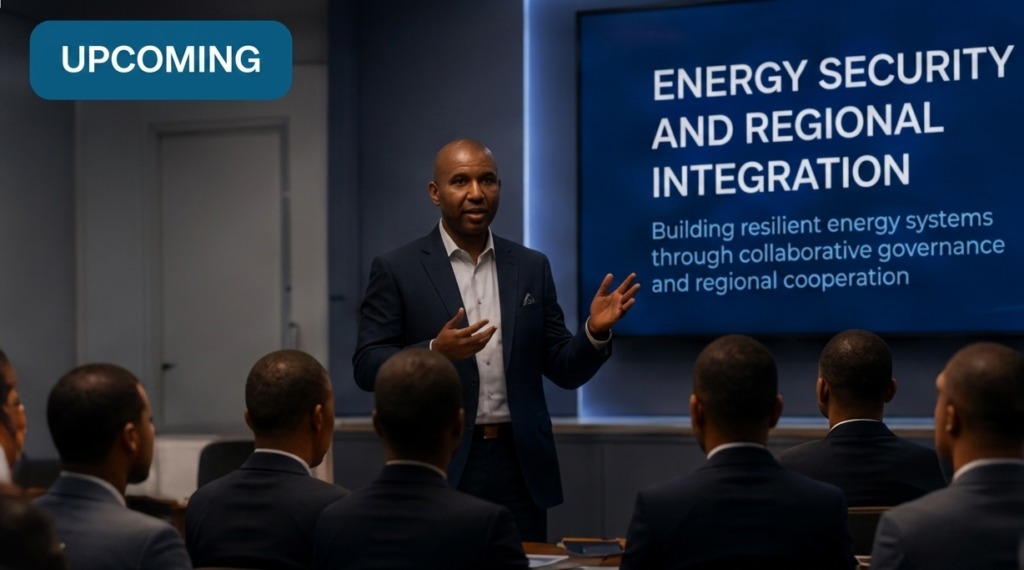
Our Programmes Connect. Collaborate. Create Impact. The Strategic Domains Council governments, organisations, institutions, professionals and development partners to engage with us across multiple pathways. Together we can strengthen governance, build capacity and deliver sustainable solutions for Africa’s strategic future Executive Training Programme on Energy Governance Building Leadership Capacity for Effective Energy Governance, Risk Management, and Regional CooperationEnergy transition, energy security, and universal energy access represent three of the most critical socio-economic imperatives facing African nations today. While the continent possesses vast renewable energy potential alongside substantial conventional energy reserves, expanding electricity access, stabilizing industrial grids, and attracting private capital require robust institutional governance, adaptive regulatory oversight, and bankable policy frameworks. Managing these complex transition dynamics requires public and private sector leaders who can navigate global decarbonization demands while safeguarding domestic energy reliability and national socio-economic growth.The Executive Training Programme on Energy Governance provides senior public sector officials, energy corporate leaders, regulatory directors, and development finance specialists with advanced strategic and operational tools. Designed to bridge policy vision with execution, the programme balances immediate hydrocarbon security and baseload requirements with long-term renewable energy integration, project risk mitigation, and cross-border power trading across sub-Saharan Africa.Key Learning ModulesRegulatory Frameworks & Policy Reform Investor-Friendly Policy Design: Drafting transparent, predictable regulatory frameworks and tariff structures that mitigate political risk and incentivize Independent Power Producer (IPP) investments. Power Sector Unbundling & Liberalization: Navigating structural reforms across generation, transmission, and distribution assets to build competitive, financially viable electricity markets. Public-Private Partnership (PPP) Structuring: Designing balanced concession agreements, Power Purchase Agreements (PPAs), and government guarantee instruments to de-risk capital-intensive energy developments. Regional Power Pools & Cross-Border Governance Power Pool Architecture & Interconnection: Analyzing the operational mechanics, wheeling tariffs, and cross-border trade agreements governing regional power trading entities such as the West African Power Pool (WAPP) and Eastern Africa Power Pool (EAPP). Grid Synchronization & Technical Standards: Harmonizing transmission codes, dispatch protocols, and frequency controls to ensure operational stability across interconnected national grids. Cross-Border Dispute Resolution: Establishing institutional legal frameworks for managing regional trade defaults, inter-utility contract disputes, and sovereign risk liabilities. Risk Management in Energy Projects Geopolitical & Macroeconomic Risk Mitigation: Assessing currency volatility, off-taker credit risks, inflation pressures, and political exposure in long-term energy infrastructure investments. Environmental & Social Impact Governance: Enforcing rigorous Environmental, Social, and Governance (ESG) standards, community resettlement frameworks, and environmental compliance audits. Asset Protection & Operational Security: Safeguarding critical power infrastructure—including SCADA networks, smart meters, generation plants, and high-voltage transmission corridors—against physical sabotage and cyber threats. Just Transition & Renewable Integration Baseload Stabilization & Natural Gas Strategy: Utilizing natural gas as a strategic transition fuel to supply reliable baseload power alongside expanding solar, hydro, wind, and geothermal assets. Grid Modernization & Energy Storage Systems: Deploying Battery Energy Storage Systems (BESS), smart grid automation, and demand-response capabilities to integrate variable renewable energy inputs without compromising grid stability. Climate Finance & Carbon Market Monetization: Leveraging green bonds, concessional finance, carbon offsets, and multilateral transition funds to lower the cost of capital for clean energy projects. Target Audience Ministry & Policy Leadership: Permanent secretaries, directors-general, and senior policy advisors from national ministries of energy, power, petroleum, and natural resources. Regulatory Commissions & Oversight Bodies: Board directors, commissioners, and chief economists from national electricity regulatory authorities and utility oversight panels. Utility & Power Sector Executives: Chief Executive Officers, Chief Operating Officers, and strategic planning directors from state-owned power utilities, private IPPs, and transmission system operators. Investment & Advisory Specialists: Energy infrastructure bankers, legal counsel, risk analysts, and development finance institution (DFI) representatives executing regional power sector investments.
SDC African Aviation Domain Retreat 2026

Our Programmes Connect. Collaborate. Create Impact. The Strategic Domains Council governments, organisations, institutions, professionals and development partners to engage with us across multiple pathways. Together we can strengthen governance, build capacity and deliver sustainable solutions for Africa’s strategic future SDC African Aviation Domain Retreat 2026 Strategic Aviation and the Governance of Africa’s Aviation Domain: Integrating Interdependent Strategic Domains for Safe, Secure, Sustainable, and Competitive Air TransportAir connectivity across the African continent serves as an indispensable catalyst for regional socio-economic integration, economic diversification, and the seamless movement of goods and people under the African Continental Free Trade Area (AfCFTA) framework. Despite its immense potential, Africa’s aviation domain remains constrained by high operational expenditures, fragmented air traffic management protocols, complex inter-country visa requirements, restrictive bilateral air service agreements (BASAs), and legacy regulatory bottlenecks. Overcoming these systemic hurdles requires unified governance, strategic policy alignment, and cross-border collaboration to build a safe, secure, sustainable, and globally competitive African sky.The SDC African Aviation Domain Retreat 2026 serves as a high-level strategic platform convening civil aviation authorities, airline executives, safety regulators, air navigation service providers (ANSPs), airport operations managers, and international trade policy architects. The retreat focuses on operationalizing the Single African Air Transport Market (SAATM), modernizing critical aviation infrastructure, enhancing safety oversight mechanisms, and establishing sustainable operational models tailored to the economic realities of the continent.Key Deliberation PillarsAccelerating SAATM Implementation Market Liberalization & Policy Harmonization: Unlocking administrative and regulatory barriers, eliminating protectionist bilateral air service agreements, and granting fifth-freedom traffic rights to establish a fully liberalized single African sky. Airline Competitiveness & Cost Reduction: Addressing prohibitive operational expenditures, excessive jet fuel surcharges, and punitive aviation taxes to lower airfares, boost passenger traffic, and improve profitability for regional carriers. Fair Competition & Industry Governance: Establishing robust anti-monopoly frameworks, joint dispute-resolution mechanisms, and commercial partnership models to foster fair competition between state-owned and private airlines. Aviation Infrastructure & Airspace Governance Next-Generation Air Navigation Systems: Upgrading satellite-based air traffic management systems, communication protocols, and surveillance infrastructure across interconnected Flight Information Regions (FIRs). Airport Infrastructure & Capacity Expansion: Investing in terminal modernizations, runway expansions, and smart passenger processing systems to handle growing travel volumes and improve operational throughput. Digital Border Management & Interoperability: Implementing automated biometric e-gates, integrated customs processing, and streamlined visa-on-arrival frameworks to facilitate frictionless transit across regional aviation hubs. Sustainable Aviation & Carbon Offset Strategies Sustainable Aviation Fuel (SAF) Production & Adoption: Formulating policy roadmaps and investment frameworks to build domestic SAF supply chains, leveraging Africa’s agricultural feedstock and green energy potential. Green Airport Operations & Energy Transition: Deploying solar energy micro-grids, energy-efficient terminal architecture, and electric ground support equipment to reduce the carbon footprint of airport operations. Carbon Offsetting & Compliance Frameworks: Aligning continental aviation strategies with the Carbon Offsetting and Reduction Scheme for International Aviation (CORSIA) while defending equitable transition timelines for African operators. Aviation Risk Management & Safety Oversight ICAO Standards Harmonization: Aligning national civil aviation regulations, safety management systems, and audit protocols with International Civil Aviation Organization (ICAO) Standards and Recommended Practices (SARPs). Regional Safety Oversight Organizations (RSOOs): Strengthening regional safety bodies to conduct joint safety audits, personnel licensing, and continuous airworthiness monitoring across member states. Insurance Risk Reduction & Asset Security: Enhancing sovereign safety records, aircraft registration oversight, and legal protections to reduce operational insurance premiums and lower aircraft leasing costs for regional airlines. Target Audience Civil Aviation Leadership: Directors-General, board executives, and policy directors from national Civil Aviation Authorities (CAAs). Airline C-Suite & Executives: Chief Executive Officers, Chief Operating Officers, and fleet strategy directors from flag carriers, regional airlines, and private operators. Infrastructure & Navigation Operators: Managing directors of airport authorities, air navigation service providers (ANSPs), and ground handling institutions. Security & Trade Policy Directors: Aviation security directors, trade ministers, international legal experts, and representatives from regional economic communities (RECs).
SDC West African Maritime Strategic Retreat 2026

Our Programmes Connect. Collaborate. Create Impact. The Strategic Domains Council governments, organisations, institutions, professionals and development partners to engage with us across multiple pathways. Together we can strengthen governance, build capacity and deliver sustainable solutions for Africa’s strategic future SDC West African Maritime Strategic Retreat 2026 Governing the West African Maritime Domain: Integrating Interdependent Strategic Domains for Maritime Security, Safety, and Sustainability in the Gulf of GuineaThe Gulf of Guinea represents one of the world’s most critical yet geopolitically complex maritime domains. Accounting for a vast proportion of global crude oil exports, crucial commercial shipping lanes, and rich marine ecosystems, the region is vital to continental trade and international economic stability. However, the West African maritime space faces severe, interconnected security threats—ranging from piracy, armed robbery at sea, and crude oil theft to Illegal, Unreported, and Unregulated (IUU) fishing, narcotics trafficking, and marine environmental degradation. Overcoming these multi-faceted maritime challenges requires transitioning away from fragmented national defenses toward integrated regional governance, robust inter-agency execution, and continuous cross-border operational alignment.The SDC West African Maritime Strategic Retreat 2026 gathers senior naval commanders, maritime safety administrators, national defense strategists, judicial officers, and blue economy leaders across West and Central Africa. The retreat focuses on evaluating, modernizing, and operationalizing the regional maritime security architecture established under the Yaoundé Architecture. By breaking down operational silos between military forces, civil maritime regulators, and environmental custodians, the retreat aims to accelerate actionable policy solutions, optimize maritime domain awareness, and streamline judicial prosecution pathways for maritime crimes across the Gulf of Guinea.Key Deliberation PillarsInter-Agency Cohesion & Architecture Harmonized Command & Judicial Pipelines: Synchronizing joint operational command structures among naval forces, maritime police, coast guards, and judicial authorities to accelerate the arrest-to-prosecution pipeline for maritime criminals. Operationalizing the Yaoundé Architecture: Strengthening information sharing, joint patrol protocols, and operational readiness across Regional Maritime Security Centres (CRESMA/CRESMAC) and Inter-Regional Coordination Centres (ICC). Legal Framework Harmonization: Standardizing national maritime security legislation, piracy prosecution laws, and extradition treaties across Gulf of Guinea states in alignment with UNCLOS standards. Blue Economy Governance & Environmental Protection Combatting IUU Fishing: Deploying joint monitoring mechanisms, satellite tracking, and strict fishing vessel licensing protocols to eradicate illegal fishing and preserve coastal artisanal livelihoods. Marine Pollution & Environmental Safeguards: Formulating rapid response protocols for offshore oil spills, industrial waste dumping, and coastal environmental degradation to protect marine ecosystems and coastal biodiversity. Sustainable Maritime Trade & Resource Management: Balancing off-shore resource extraction with marine spatial planning (MSP) and sustainable blue economy investments that foster regional prosperity. Technology-Driven Maritime Domain Awareness (MDA) Integrated Surveillance Systems: Fusing data from satellite synthetic aperture radar (SAR), Automatic Identification Systems (AIS), coastal radar networks, and long-range identification tracking (LRIT). Unmanned & Autonomous Platform Deployment: Incorporating Unmanned Aerial Systems (UAS) and autonomous maritime vehicles to expand surveillance footprints over remote economic exclusion zones (EEZs). Real-Time Intelligence Sharing: Establishing encrypted, multi-agency data networks to instantly broadcast threat vectors and suspicious vessel profiles across regional maritime operations centers. Port State Control & Coastal Infrastructure Security Port Security Compliance & ISPS Code: Enforcing strict compliance with International Ship and Port Facility Security (ISPS) Code benchmarks across all West African commercial ports and offshore terminals. Critical Coastal Asset Protection: Securing offshore oil rigs, floating production storage units (FPSOs), subsea telecommunication cables, and strategic anchorage areas from asymmetric threats. Streamlined Port State Inspections: Enhancing joint customs and port authority inspection capacity to intercept illicit contraband, weapons trafficking, and unregistered vessels. Target Audience Naval & Defense Leadership: Chiefs of Naval Staff, Coast Guard Commanders, and Directors of Military Operations across West and Central African nations. Maritime Safety & Administration Officials: Directors-General and board executives of national maritime safety agencies and port state control administrators. Policy & Cabinet Ministers: Ministers of Defense, Transport, Foreign Affairs, Environment, and the Blue Economy. Port & Coastal Infrastructure Executives: Port authority managing directors, offshore terminal operators, subsea infrastructure managers, and maritime logistics leaders. Legal & Judicial Experts: Attorneys-General, maritime law drafters, prosecutors, and international law scholars specializing in law of the sea. International Security Partners: Representatives from international naval coalitions, UNODC, IMO, regional economic communities (ECOWAS/ECCAS), and maritime defense attachés.